Some links on this page are shopping links. If you buy through one, HousewareHounds may earn a commission at no extra cost to you.
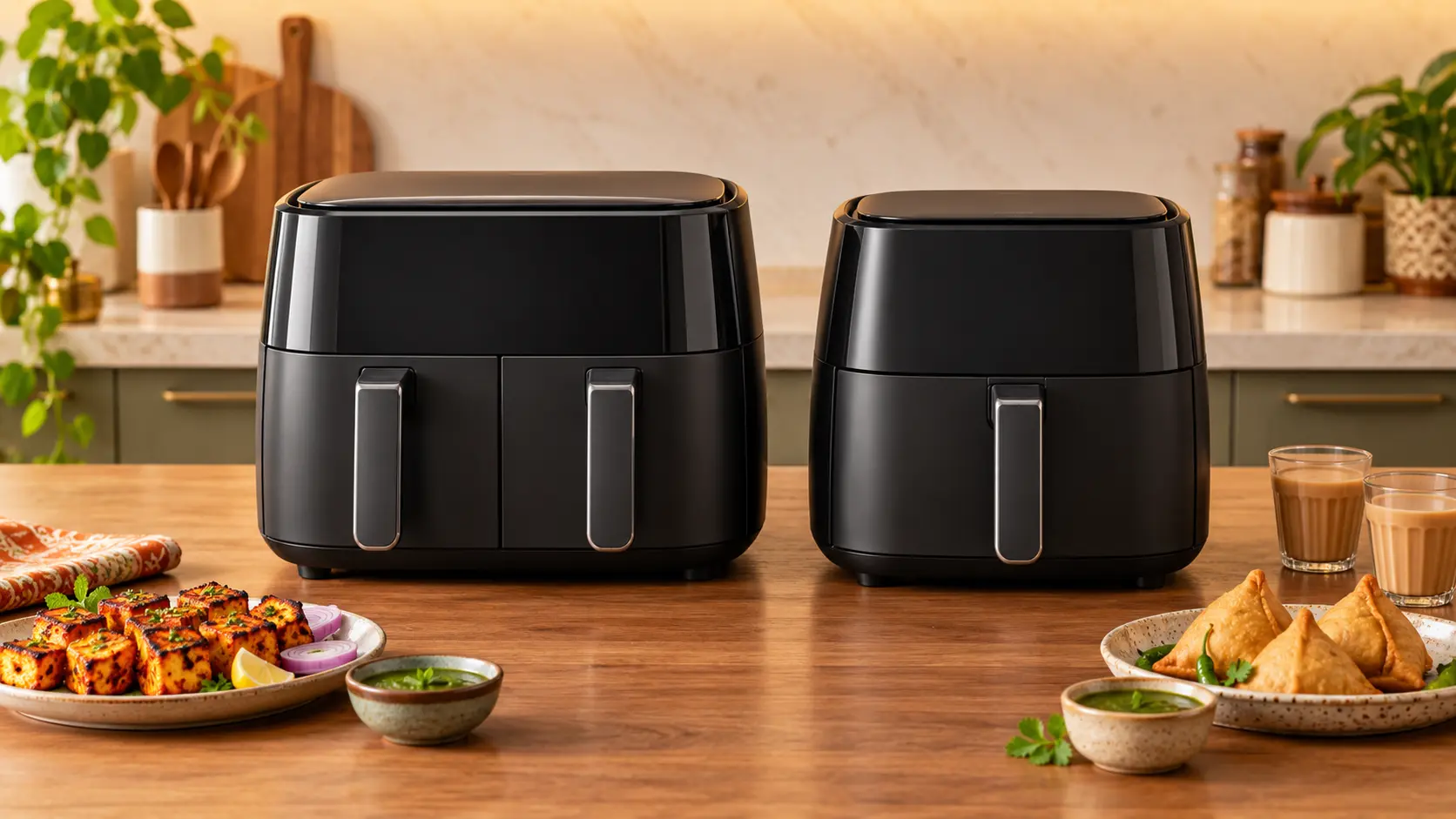
Imagine a Sunday evening when paneer tikka is marinating in one bowl, frozen samosas are waiting in another, and everyone wants both served hot. A dual-basket air fryer sounds made for that moment: paneer in one drawer, samosas in the other, two temperatures, one finishing time.
Now picture an ordinary Tuesday. You are cooking one generous batch of aloo, kebabs or vegetables, and half of an expensive second drawer would sit empty. In that kitchen, a wide single basket may be simpler, easier to clean and kinder to your counter space.
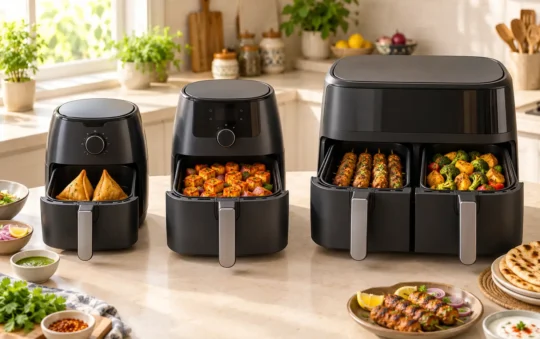
That is the real decision. A dual-basket model is not automatically “better” because its total litre number is larger. You are choosing between two independent cooking zones and one continuous cooking surface.
If capacity is your first concern, read our 4L vs 6L vs 8L air-fryer size guide for Indian families. For a broader product shortlist, see our best air fryers for Indian cooking.
Dual basket vs single basket: the practical difference
Dual basket
Best at: cooking two different foods together.
Useful when: paneer needs 180°C while samosas need a hotter or longer cycle; one drawer can finish later and the sync function coordinates the end.
Main compromise: the total capacity is divided. A “9L” model may not accept one 9L-sized batch.
Single basket
Best at: giving one food the largest uninterrupted area available.
Useful when: you want one layer of tikka, vegetables, fish fillets or snacks without a divider taking up width.
Main compromise: two foods with different settings must be cooked sequentially or carefully timed together.
The litre number can mislead you
The Philips NA352/00 is advertised as a 9L dual-basket model, but its capacity is split into a 6L main drawer and a 3L secondary drawer. That arrangement is clever for a main dish plus a side. It is less clever if you expected two equal family-sized baskets—or one enormous 9L tray.
By comparison, the Philips NA231/00 places its stated 6.2L in one drawer. On paper, 9L sounds far larger than 6.2L. In practice, the larger drawer of the dual model and the complete single drawer are in a similar broad capacity class. What changes is that the dual model adds a separate 3L zone.
Indian meal scenarios: where each format wins
Paneer tikka plus samosas for guests
Dual basket wins. The foods begin with different moisture levels and often want different timings. Independent drawers stop the wetter paneer marinade from sharing space with pastry that needs dry circulating air.
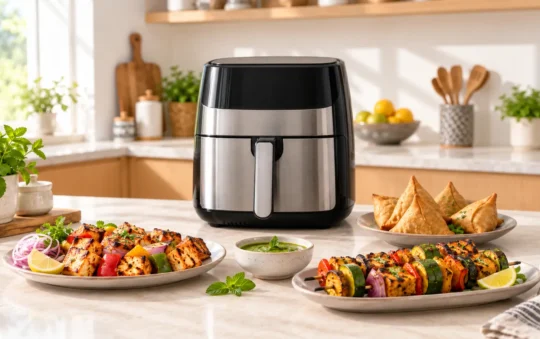
One large batch of paneer or chicken tikka
Single basket often wins. One wide surface is easier to arrange than splitting the batch across unequal drawers. The goal is spacing, not merely volume.
Vegetarian and non-vegetarian food at the same time
Dual basket can help with separation, but the appliance still shares an exterior and airflow system. Households with strict dietary separation should follow their own utensil and appliance rules rather than assuming two drawers equal two completely isolated kitchens.
Reheating yesterday’s snacks
Single basket is usually enough. If the job is a plate of samosas or pakoras, a second drawer adds little. Our samosa and pakora reheating guide explains the short-cycle method.
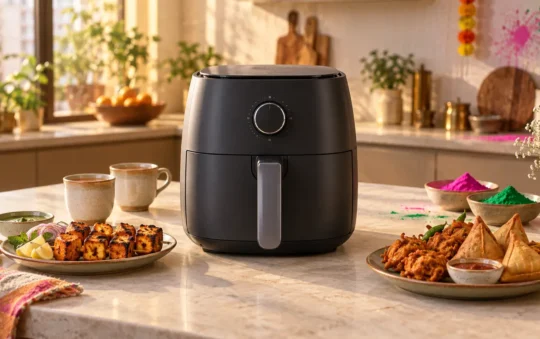
Holi, Diwali or a family chai session
Dual basket becomes genuinely useful when the menu—not the headcount—creates two cooking jobs. One drawer can handle savoury snacks while the other keeps a different batch moving without turning dinner into a relay race.
Representative models: what the specifications reveal
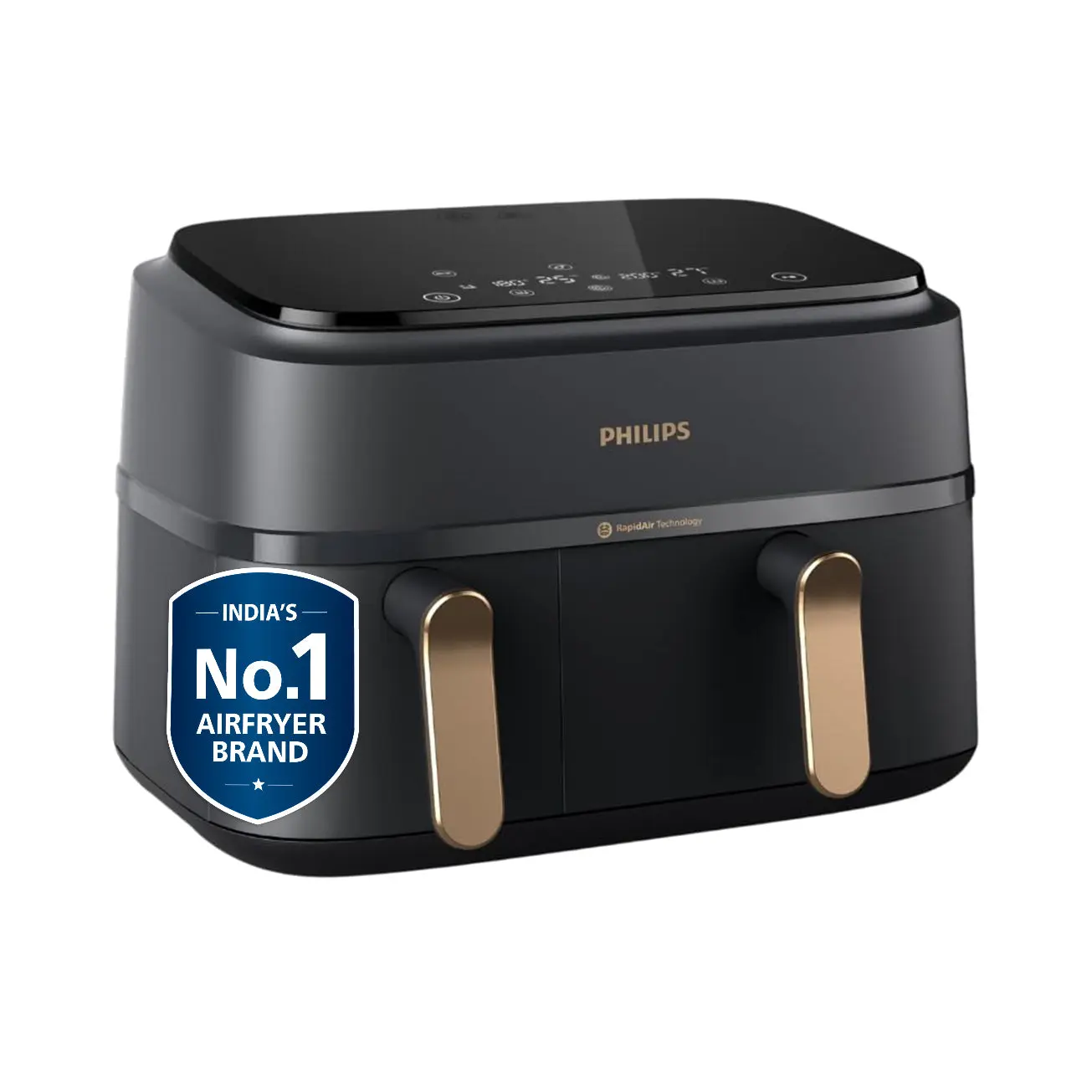
Philips NA352/00
9L total (6L + 3L) · 2750W · 40–200°C · 8 presets · sync finish · 2-year warranty
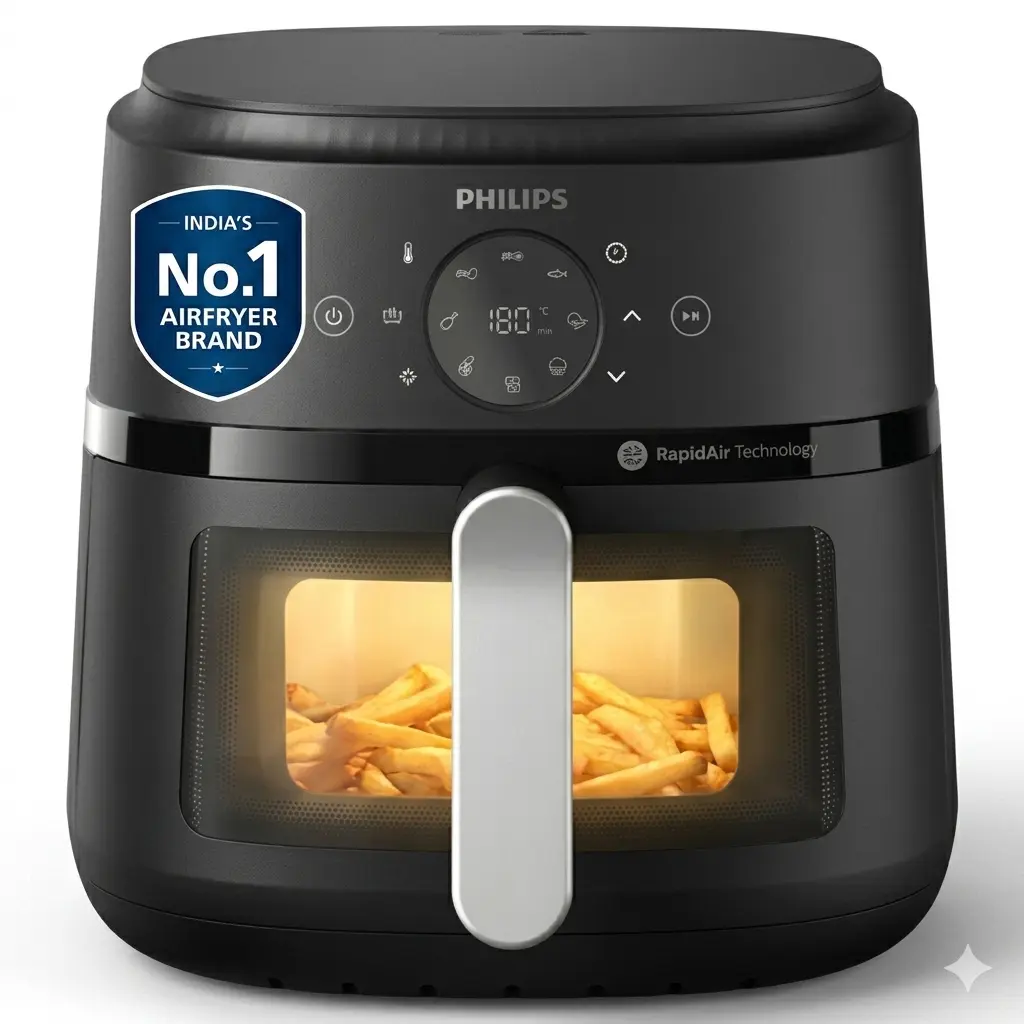
Philips NA231/00
6.2L single drawer · 1700W · touch controls · viewing window · 13 presets · 2-year warranty
Product images: Philips India official product pages.
Philips NA352/00: why the dual-basket design works
The NA352/00 uses an asymmetric 6L + 3L arrangement. That is more practical for many Indian meals than two equal small drawers: the large side can hold the main batch, while the smaller side handles vegetables, fries or snacks.
Philips lists 2750W power, a 40–200°C range, eight presets, a 1.8m cord, a two-year warranty and dimensions of 314 × 382 × 444mm. The product weighs 7.85kg. Those numbers describe a serious countertop appliance, not something most people will lift into a cupboard after every meal.
Why it scores well: meaningful two-zone cooking, a large primary drawer, synchronized finishing and documented Indian warranty support.
Who should skip it: couples who mainly cook one item, homes with limited counter depth, buyers who rarely need two temperatures, and kitchens where a 2750W appliance has not been checked against the intended socket and circuit.
Price context: Philips India listed it at ₹15,499 when checked on 12 October 2026. Prices can move sharply during festive sales, so compare the exact NA352/00 model rather than a vague “Philips dual air fryer” listing.
Philips NA231/00: why one drawer can still be the smarter buy
The NA231/00 provides a single 6.2L drawer with 1700W heating, digital controls, a viewing window and a two-year warranty. Its appeal is not that it can imitate two independent zones. It cannot. Its advantage is that the entire drawer remains available for one batch.
That matters for paneer tikka, kebabs, fish fillets and vegetables that benefit from spacing. There is no narrow second compartment forcing a large batch into an awkward shape.
Why it scores well: strong family-size single-drawer capacity, lower stated power than the dual model, simpler cleaning and a viewing window for checking browning.
Who should skip it: families that frequently cook a main and side at different temperatures, or anyone tired of running two consecutive batches every evening.
Price context: Philips India listed it at ₹9,999 when checked on 12 October 2026. That roughly ₹5,500 gap is large enough to ask a blunt question: will you use the second zone several times each week?
Power, plug and counter-space reality
The dual Philips is rated at 2750W; the single-basket NA231/00 at 1700W. Wattage is not a direct promise of better food, but it affects the electrical load and the way the appliance recovers heat.
Before buying a high-wattage dual model, check the current product label/manual, the supplied plug and the socket you intend to use. Do not plan to run it through a light-duty extension board. If the socket or circuit suitability is unclear, an electrician is cheaper than improvisation.
Counter space is equally practical. The NA352/00 is 444mm deep according to Philips. Add ventilation clearance and room to pull both hot drawers forward. A product that technically fits the counter but blocks a cabinet or lives beside the sink is not a good fit.
Cleaning: two drawers also mean two sets of parts
A dual-basket air fryer can save cooking time and add washing time. Two baskets and two inserts collect oil, crumbs and marinade. For dry frozen snacks, that difference is small. For hariyali tikka, malai paneer or masala-coated vegetables, it becomes noticeable.
If both drawers were used, clean both after they cool—even if one appears less dirty. Residue around handles, corners and removable plates becomes harder to remove after repeated heating. A single basket is plainly easier when most meals use only one food.
Does a dual basket use twice the electricity?
Not automatically. Electricity use depends on power draw, temperature, duration and whether one or both zones are active. A dual model can avoid two sequential cooking cycles, but its higher rated power means you should not assume it is cheaper to run.
The fair comparison is your actual meal: two dishes cooked together in one dual-basket session versus one dish followed by another in a single basket. Our upcoming electricity-cost guide will calculate those scenarios using Indian tariff examples rather than making a blanket claim.
Our decision guide
Buy a dual-basket air fryer if:
- you regularly cook a main and a side at different temperatures;
- your first batch often becomes cold while the second cooks;
- family or festive snack sessions are common;
- you have verified the counter space and electrical setup;
- the second drawer will be used weekly, not merely admired on day one.
Buy a single-basket air fryer if:
- most meals involve one main food;
- you want the widest uninterrupted cooking area for the price;
- counter space, cleaning effort and budget matter more than multitasking;
- you are cooking mainly for one or two people—our air fryer guide for two-person homes goes deeper;
- you would rather buy a strong 6L-class single basket than a cheaper dual model with two cramped drawers.
Final verdict
For most Indian homes, a good single-basket air fryer remains the sensible default. It is cheaper, simpler and usually better for one generous batch.
A dual-basket model earns its extra cost when your everyday menu repeatedly creates two separate cooking jobs. Paneer plus samosas, fish plus vegetables, or snacks plus a side are the moments where synchronized drawers stop being a showroom gimmick and become useful.
The deciding question is not “How many litres can I buy?” It is: Do I need two temperatures at once, or one larger surface? Answer that honestly and the format choice becomes much easier.
Frequently asked questions
Is a dual-basket air fryer better for a family of four?
It can be, especially when a family meal includes two foods with different cooking times. If the family usually eats one large batch of the same item, a wide single basket may be more useful.
Can I cook paneer in one basket and samosas in the other?
Yes. That is one of the clearest dual-basket use cases because the wet marinade and dry pastry can use separate settings and cooking times.
Is 9L dual basket the same as a 9L single basket?
No. Dual-basket capacity is divided between separate drawers. The Philips NA352/00, for example, splits 9L into 6L and 3L.
Can I use only one drawer of a dual-basket air fryer?
Many dual-basket models allow one zone to operate independently. Confirm this in the exact model’s manual before buying.
Which format is better for two people?
A 4–6L single basket is usually the better-value starting point. A dual basket makes sense for a couple only when they frequently prepare two different foods together.